Final Testing & Results
NAVI Project Engineering Requirements
The Final Testing & Results section demonstrates how the NAVI headset was evaluated against its formal engineering requirements. Each requirement was validated through controlled tests, iterative design refinements, and performance measurements. Photos, videos, and data visualizations will be added to illustrate the outcomes of each test.
Engineering Requirement #1
360° Obstacle Detection
To verify the NAVI system’s ability to detect obstacles within a full 360° field of view, the system was tested by walking through college environments and capturing it on video. Testing confirmed that the sensors consistently identified obstacles in every direction, and multi-height detection performed reliably across typical indoor distances. The image below shows strong agreement validating the system’s IR sensors functioning in their respective fields of view. The video was a student who volunteered to try out the prototype and provide feedback.

Engineering Requirement #2
Haptic/Sensor Response Time
To measure haptic/sensor response performance, the time between obstacle detection and vibration activation was recorded using video timing markers
The results demonstrated that NAVI, using a high-frame-rate video of an indicator LED tied to the motor control signal, that the system’s electrical response time from command to actuator is estimated at approximately 60 ms, with an uncertainty of about ±20 ms due to video frame resolution.
Engineering Requirement #3
Total System Weight, Comfortable Fit
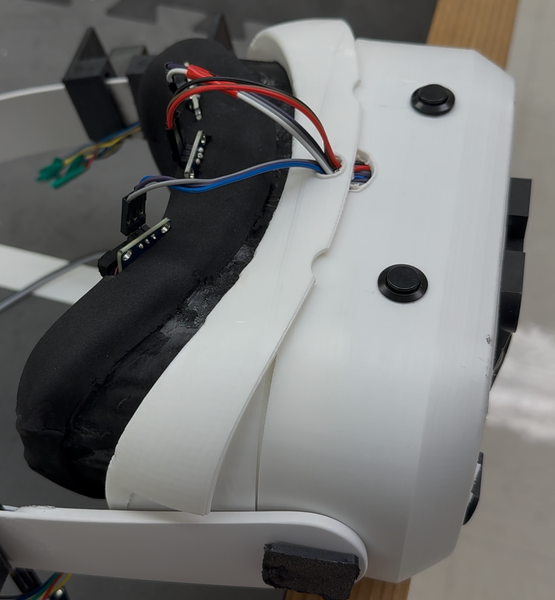
The assembled NAVI headset was weighed and confirmed to remain under the 2.5-lb weight limit. Following this, the system was tested by several of our peers in response to our request for them to wear the device ad provide any feedback.
Users reported a secure and comfortable fit, with no excessive pressure points or shifting during walking tests. The device was stated to be slightly forward heavy but that of course would be in response to the component housing with most of our components and wiring at the front of the device.

Engineering Requirement #4
Minimum Battery Runtime
To verify that the NAVI system could operate for a minimum of 3 hours on a single charge, a full-duration battery discharge test was performed under continuous use. The resulting discharge curve, shown in the graph below, demonstrates a smooth and predictable decline from 82% at the start of the test to 0% at shutdown, with the total runtime exceeding 400 minutes (approximately 6 hours and 40 minutes). This result demonstrate the NAVI system is capable of extended real-world operation without requiring frequent recharging. The linear trend of the dotted line further confirms that the battery drain is stable and consistent throughout the test, with no unexpected drops or spikes. In addition to runtime testing, the recharge requirement was also evaluated by fully draining the system and measuring the time required to return to 100% charge using the standard USB-C connection. The system successfully recharged in under 2 hours, satisfying the requirement for quick turnaround between uses.

Engineering Requirement #5
Safe Thermal Performance
To confirm that the NAVI system operates safely within acceptable thermal limits, a series of temperature measurements were taken during extended use. Using a handheld IR thermometer, multiple surface points—including the sensor housings, side enclosures, electronic cavities, and regions making direct contact with the user—were monitored over the course of normal system operation. Across all measurement locations, the observed surface temperatures remained well within safe and comfortable limits. None of the readings approached thresholds associated with thermal discomfort or injury, even after prolonged use. The thermal images show consistent surface temperatures that remained stable over time, indicating that heat generated by the electronics is effectively distributed and does not accumulate in user-contact areas.


Engineering Requirement #6
Haptic Power & Battery Status Indicators
The system’s haptic indicators for power state and battery level were tested under both normal and low-battery conditions. Users were asked to confirm the recognizability and consistency of each tactile pattern.
The indicators reliably triggered during state changes, and users could easily distinguish between power-on vibrations and battery charge alerts..

Engineering Requirement #7
Light Dust & Water Resistance (IP52 Standard)
During the IP52 drip-resistance pre-test analysis, the NAVI enclosure did not meet the required protection level. Visual inspection revealed points where water was able to penetrate the housing. These gaps, influenced by a need for path changes on the wiring harnesses for certain haptic motors would allowed moisture to accumulate inside the device. Because the enclosure failed to prevent water ingress under controlled conditions, NAVI did not achieve IP52 compliance.


Engineering Requirement #8
Adjustable Feedback Intensity
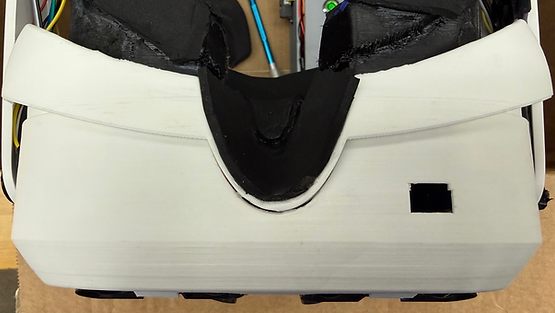
The system successfully integrates a momentary push button that enables users to switch between multiple haptic feedback modes in real time. Firmware logic was refined so that each mode corresponds to a distinct vibration intensity, allowing the actuator’s output to scale consistently and predictably. During testing, the transition between modes was smooth, responsive, and easy for users to understand, demonstrating reliable and intuitive control over feedback strength.